

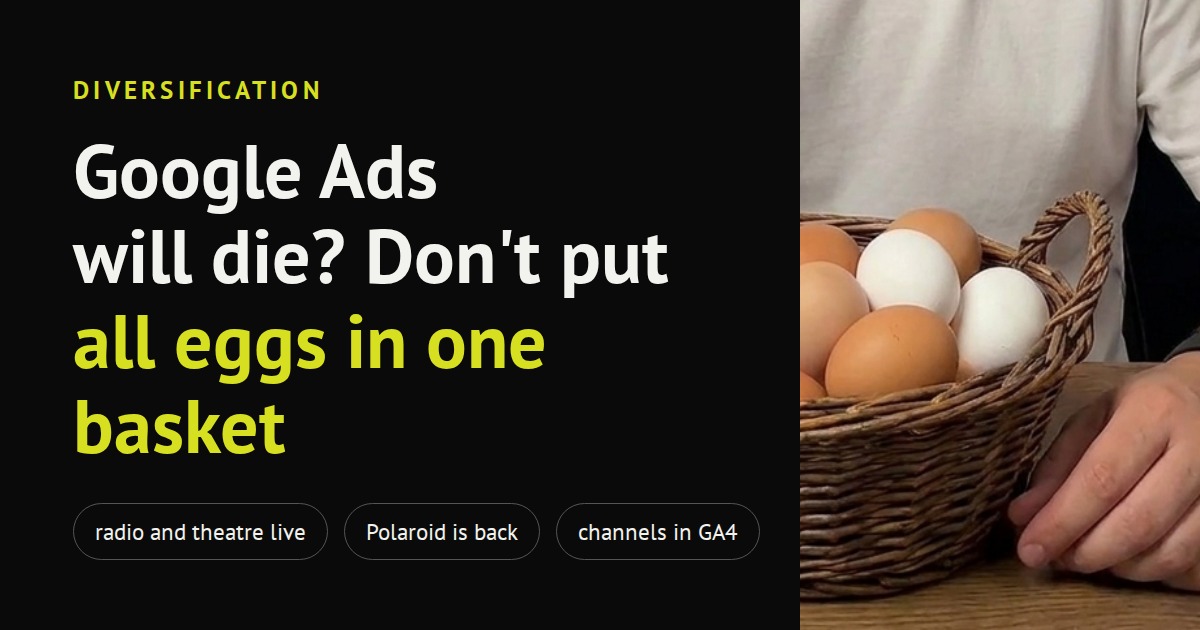
“Google Ads will die, and AI will take over everything.” Business owners hear this almost every week, and afterwards they often want either to rebuild everything in a hurry or to do nothing at all. Both are bad options. Below: what has happened before, what fresh numbers say about AI traffic, and what you can do this week so you don’t depend on a single source of leads.
A word on limits first. We don’t know what search will look like in five years, and nobody does. So there are no predictions here like “Google will disappear” or “AI is a minor thing”. There are verified facts with dates and one practical conclusion.
1. Humanity has been through this before
Every new medium was said to be about to kill the previous one. Let’s see what actually happened.
Radio after television. When television arrived, it took drama, comedy and advertisers away from radio. Radio did not vanish; it changed, moving to music and local broadcasting. According to a media-culture textbook, older media mostly adapt instead of disappearing.
Theatre after cinema. Cinema, and then television, really did shrink theatre’s mass role: it became smaller and, by some assessments, never regained its former weight. But it did not disappear. It lives in its own niche, where a screen cannot replace being in the room. Sources differ here: some stress that theatre survived, others that it never recovered. For our conclusion it is enough that it did not die.
Offline advertising after the internet. This is an observation, not a statistic: by the roadside, in the metro and on shop doors, advertising has not gone anywhere. It stayed where people don’t have a phone in their hand.
Polaroids. The best example. In 2008 Polaroid was closing its film factories, and it looked as if instant photography was over. From 2009 a group of enthusiasts, The Impossible Project, bought part of the equipment and recreated the film almost from scratch. In 2017 they bought the brand and became Polaroid Originals, and in March 2020 simply Polaroid again. So “Polaroids are on sale again” is true, but it is a comeback under different owners and with new technology. The product found its niche; it did not win back the whole market.
All four stories have one thing in common: the old does not vanish, it takes a niche. With search and AI it will most likely be similar, but we don’t control the niche, so the risk remains that it shifts precisely against your business.
2. What the numbers say about AI traffic
There is data you can check. Ahrefs (an SEO service) tracks traffic of more than a hundred thousand websites. According to its October 2026 update (115,254 sites, June 2025 to September 2026), the picture is:
- Google brings about 24% of all tracked website traffic (23.96% in September 2026);
- all AI assistants together, meaning ChatGPT and similar, bring about 0.4% (0.43%), of which ChatGPT alone is 0.34%;
- in September, visitors from ChatGPT grew by 14.1% compared with August, while visitors from Google fell by 2.7%.
Two things need to be held in mind at once.
AI traffic is still small. By our own calculation, Google brings roughly 55 times more visitors than all AI assistants together. Earlier, Ahrefs counted this gap in hundreds of times: in 2025 its studies mentioned both 345 and 210 times. The numbers differ because the sample of sites and the period are different each time. So don’t memorize an exact figure, remember the order of magnitude: on average Google remains the main source and AI a small part.
But it is growing. In June 2025 Ahrefs wrote that AI traffic had grown about 9.7 times over the year (a sample of 81,947 sites), and at that time it was on average 0.25% of a site’s traffic. Small, but not standing still.
What the numbers don’t say: what will happen in your business. These are averages across thousands of sites. In your niche the AI share may be much larger or almost zero. You can only find out from your own analytics, and how to do that is below.
3. Why the risk is in a single channel
Even if Google Ads doesn’t die, depending on it alone is dangerous for ordinary reasons: an account can be suspended, the cost per click can rise, a competitor can raise bids, the results can change. An owner whose leads all come from one source experiences any such event as an emergency. One with several sources feels it as an inconvenience.
This is not fear, it is arithmetic: the more independent sources you have, the less any one of them weighs.
4. Where else to get leads
You don’t need to launch everything at once. Here is a list from which to pick one or two:
- Google Ads search advertising. Brings leads in days, not months, but works only while you pay. See how we run it on the search advertising page.
- Social networks and Meta ads (Instagram and Facebook). A different principle: you show yourself to people who weren’t searching. Ads can be launched quickly here, while organic posts need regularity.
- SEO, the free search results. It takes long to build: Google writes about weeks and months, practitioners say 3 to 6 months to a first effect. More in the article Google Ads or SEO: Pros and Cons.
- E-mail and your customer base. People who have already bought come back at the lowest cost. Even a simple mailing once a month is enough.
- Google Business Profile and Maps. For a local business this is a separate source of calls and route requests. What to check in your listing is covered in Your Google Maps Listing: 6 Things to Check.
- Recommendations. The oldest channel, and it has never died. Ask satisfied customers to leave a review and tell their friends.
There is no advice like “take five channels and split the budget equally”, and we won’t invent one. The proportion is different for every business.
5. What to do yourself this week
It takes 10 minutes. You need access to Google Analytics 4 (GA4), a free Google tool that shows where your website visitors come from.
- Open GA4 and go to Reports > Acquisition > Traffic acquisition (this is how Google’s help names the path; if the report is missing from the menu, it may have been removed from the default view).
- Set the period to “last 90 days”.
- Look at the channel groups by sessions: free search, paid search, direct visits, social (free and paid), e-mail, referrals from other sites.
- If you have set up leads as key events, look not only at visitors but also at the share of leads by channel.
How to read the result. If one channel brings more than 70% of leads, treat it as a risk. Note that 70% is our heuristic, a working rule from practice, not an industry norm and not a Google requirement. It is a benchmark to ask yourself: what happens if this channel drops by half tomorrow?
Something else that matters: GA4 only sees what passed through the website. Calls from your Maps listing, messenger messages and “someone recommended you” often don’t get there. So add a simple question, “How did you hear about us?”, with every lead, and write down the answer. After a month you will see a picture that is in no report.
Summary
- Radio, theatre, offline advertising and Polaroid did not disappear, they took a niche. With search and AI it will most likely be the same.
- According to Ahrefs (September 2026), Google brings about 24% of website traffic and AI assistants together about 0.4%. AI traffic is small, but it is growing.
- The conclusion is neither “Google is finished” nor “AI is minor”, but diversification: leads from several sources.
- This week: check the channel shares in GA4. More than 70% of leads from one channel means it is time to put things in order.
You can read how we run campaigns in the search advertising and Performance Max sections.
Want a free audit of your Google Ads account? Send us a request: we will look at your account and tell you what in your ads really works and which other lead sources are worth adding.