

“Everyone searches in ChatGPT now, we need to be there right away.” Owners of shops, car services and salons hear this from friends, at webinars and in contractors’ proposals. It sounds convincing, but it is easy to test: count how many people actually get from AI answers to websites. Below: what the latest large study found, why the real number may be a little higher, and what an owner can do today without an analyst nearby.
1. What the numbers say
The study by SE Ranking came out on 18 June 2026. It used anonymised data from 101,574 websites in many countries that have Google Analytics connected, covering January 2025 to April 2026. The main results:
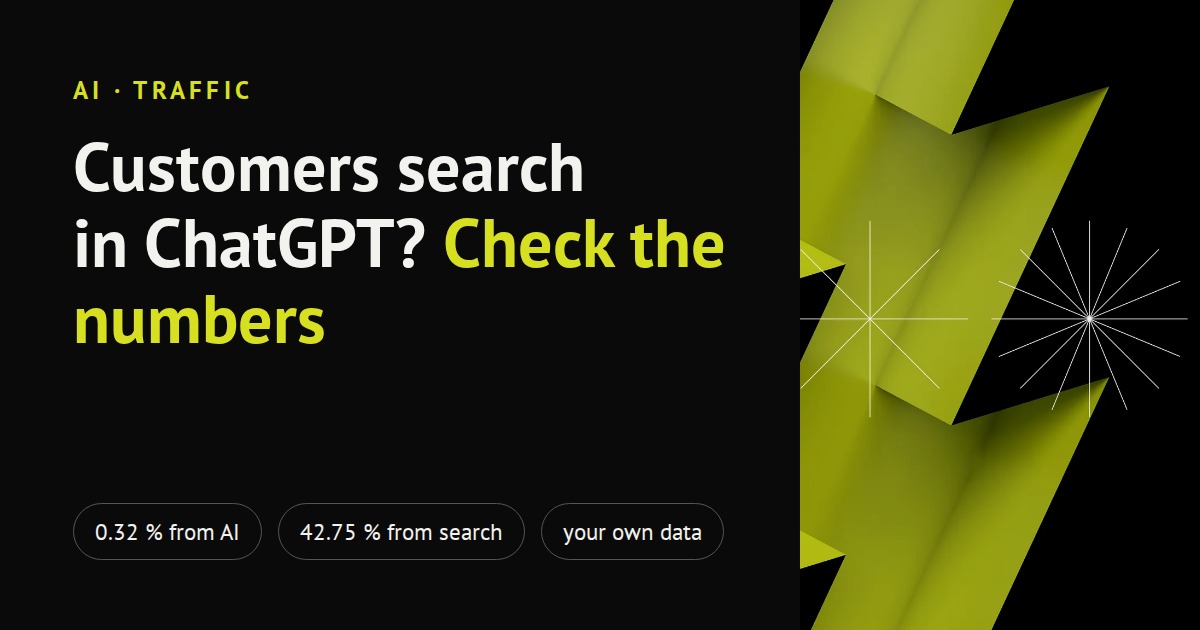
- AI platforms bring 0.32 % of all website traffic;
- organic search (free visits from Google and other search results) brings 42.75 %;
- Google, the authors say, sends 134 times more visitors to websites than all AI platforms combined.
The second figure is easy to check yourself: 42.75 divided by 0.32 is about 134. In practice that means: for every person who arrived from an AI answer there are, on average, more than a hundred who arrived from search.
Is the share growing? The numbers can be read two ways, so here are both. The researchers compared three years: 0.02 % in 2024, 0.24 % in 2025, 0.32 % in 2026. From the first value to the last, that is a 16-fold rise in under two years, as the study states. But over the last year the share added only 0.08 percentage points, and ChatGPT itself, which accounts for 74.78 % of all AI visits, grew its traffic by 27 %. So the direction is clear, the pace is moderate, and the starting point was almost zero.
One more caveat from the authors: results may not reflect the situation of every site, industry or region. For a sample of a hundred thousand sites that is a fair note: your own figure can be lower or higher.
2. Why part of the AI visits is invisible in analytics
Analytics learns where a person came from from two hints: the source site that the browser passes along with the click, and a special tag in the address (called UTM, for example utm_source=gemini). With neither, the visit lands in “direct traffic”, as if the person had typed the address by hand.
Two recent cases show how this happens; both were reported by Search Engine Roundtable:
- Gemini. From early September 2026 Google added a tag to links in Gemini answers, and around 28 September it stopped. Separately, the same report noted that the Gemini app on iOS opens links in its own window and sends no source, so in Google Analytics 4 such visits land in “direct”. On desktop the source is passed.
- ChatGPT. In June 2026 OpenAI began adding
utm_source=chatgpt.comto links. In early October, about a week after the GPT-6 release, it disappeared. According to one analytics specialist, links began to open with no tag and no source, so analytics filed those visits under direct. On 15 October the post was updated: it was a bug, and the tag was back.
What follows from this. Only these mechanisms are reliably confirmed, and only for specific weeks. We do not know how large a share of visits they swallowed on your site, and SE Ranking does not write about direct traffic or tags in this publication at all. So the honest conclusion is: the official 0.32 % may be slightly low, but it is unlikely to be off a hundredfold. Even if “hidden” traffic doubled the AI share, it would still be far from search’s forty-plus percent.
3. What this means for your money
Three thoughts help with budget decisions.
- Do not move money into “promotion in ChatGPT” just because it is fashionable. Offers that promise a place in AI answers sell a channel that on average brings fractions of a percent of visitors. That is no reason to do nothing (we wrote about checking what AI says about your business in the article “What ChatGPT says about your business”), but it is a reason not to hand over the whole budget.
- Compare with where your buyers come from. The 0.32 % is averaged over a hundred thousand sites. In your shop AI may bring more, or almost nobody. Only you can know, and you can find out in a few minutes.
- Remember that a click is not the whole effect. An AI answer often replaces the visit: a person read the address and opening hours and left, and the statistics do not show them. Why clicks in search have dropped and what it means for a site, we covered in “Why there are fewer clicks: 5 numbers about AI in Google search”.
4. How to check your site in 10 minutes
You need access to Google Analytics 4 (it must be connected to the site; if not, that is a separate task for a contractor and the place to start).
- Open GA4 and choose the last 90 days.
- On the left, select Reports, then Acquisition, then Traffic acquisition. This report shows which sources your visitors come from.
- In the search field above the table, type “chatgpt”, “gemini”, “perplexity” and “copilot” one at a time. If rows appear, write down the number of sessions.
- In the same table look at the key events column (the actions you set up as goals: an enquiry, a call, an order) and, if ecommerce is set up, total revenue. Compare: do visitors from AI bring enquiries and money, and how much compared with search.
- Separately, look at the “Direct” row. If it jumped in recent weeks while ads and mailings did not change, part of it may be “hidden” AI. That is only a guess: you can be sure only if you add your own tags.
Repeat once a month and write the numbers in a table: what matters is not a single point but the direction.
From our practice
When we review a new client’s account and site, we look at traffic sources in the first half hour: it shows what really works, not what the ads or a contractor reported. From that experience (an observation, not statistics), something else is more common: owners do not know how many visitors come from search and ads, yet they already plan a separate budget for a new channel. The order is simple: first sort out what already brings money, and only then try something new, giving it a small share.
Summary
- According to SE Ranking (101,574 sites, June 2026), AI brings 0.32 % of website traffic and organic search 42.75 %: a gap of about 134 times.
- The share is growing: 0.02 % → 0.24 % → 0.32 %. But the starting point is small and last year’s gain is modest.
- Analytics does not see part of the AI visits: since late September Gemini adds no tag, and in the iOS app the visit goes to “direct”; ChatGPT’s tag briefly vanished in early October.
- Before investing in “promotion in ChatGPT”, open GA4 and see where your buyers come from.
See how we run advertising for businesses in the section Google Ads for business.
Want a free audit of your Google Ads account? Send us a request: we will look at your account and site, show where your customers come from, and tell you where the budget is better spent.