

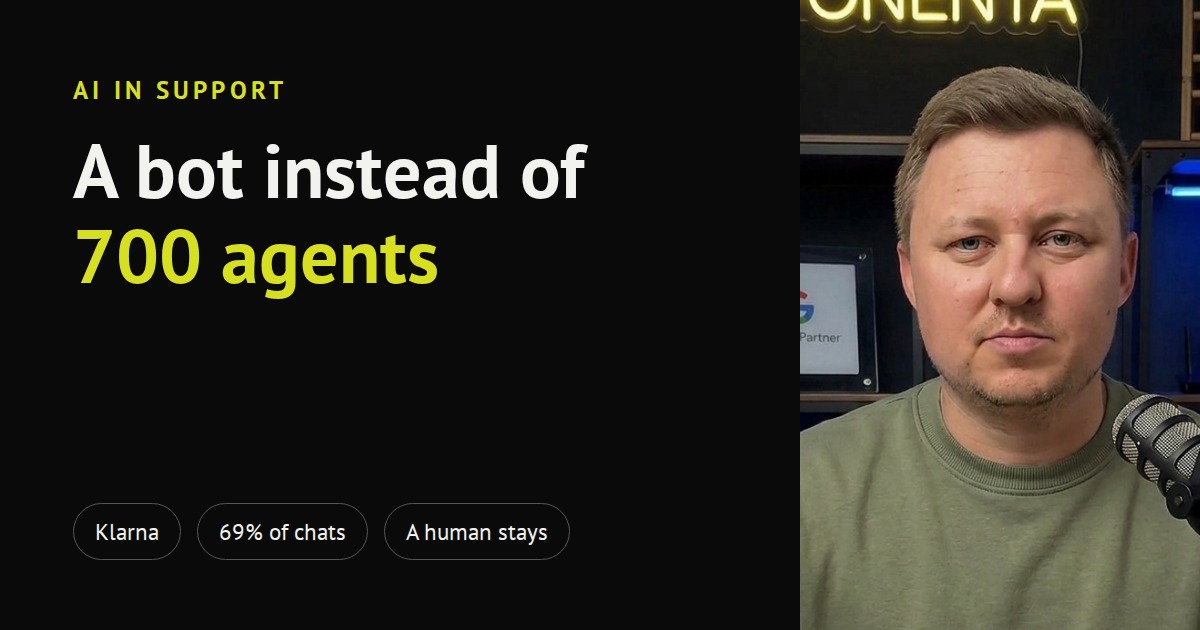
The Swedish fintech company Klarna offers shoppers instalments and pay-later options. In September 2025 it filed a prospectus with the US Securities and Exchange Commission (SEC) ahead of its stock market listing, and that document has a few lines about the AI assistant in customer support. The numbers sound loud: the bot closes most chats, and headcount fell by almost two and a half thousand people in three years. Below we go through what exactly is written there, what does not follow from it, and what to take for yourself even if you have one administrator with a phone rather than seven hundred agents.
Every figure comes from the document itself: the Klarna Group plc prospectus (Form F-1/A dated 8 September 2025), text on the SEC website. We checked it in November 2026. We did not use retellings from the news.
What Klarna wrote about its AI assistant
The assistant, built on OpenAI technology, went live in February 2024. According to the prospectus:
- in the twelve months to 30 June 2025 it handled 69% of customer chats, and since launch it has held 25.3 million conversations;
- that is work equivalent to more than 700 support staff, and Klarna states plainly that this is an estimate based on the drop in chats and calls handled by people in 2024;
- in 2024 the assistant saved about 39 million dollars;
- resolving a chat with the bot took two minutes on average, against twelve for human agents in 2024;
- it works around the clock, in 23 countries and in more than 35 languages; according to internal surveys, customer satisfaction did not fall.
The document also has headcount data. About 5,527 people at the end of 2022, 4,352 in 2023, 3,422 in 2024 and 3,098 on 30 June 2025. The gap between the first and last figure is 2,429. The prospectus calls it a deliberate decision to reduce headcount and work more efficiently with AI, and the company expects the number of people to keep falling.
What is easy to misread in these numbers
This is the company’s own data. The document is written by a seller of shares who wants to appeal to investors. The calculations rely on its own chat log and its own surveys, and the text offers no independent check. That does not make the figures false, but treating them as a laboratory result would be a mistake too.
The cut covers the whole company, not just support. Those 5.5 thousand people are the entire Klarna workforce, where roughly half the positions are engineers and data specialists. How many of those who left worked in chat the document does not break down. So the headline “the bot replaced 2,400 agents” would be an exaggeration, whereas “headcount fell by 2,429, and the company attributes it to AI” is accurate.
“700 employees” is a calculation. The text gives no names or numbers of people let go from support specifically.
The bot closed 69% of chats, not of all requests. The figure says nothing about calls or email.
Klarna handles millions of chats. That volume alone makes automation profitable. A shop with a hundred requests a week has nothing to save at the same scale, and expecting millions of dollars would be unrealistic. A small business gains something different: a quick reply at three in the morning and less repetitive work for a live person.
The key sentence in the document: people were not removed
For a small business the most useful thing, in our view, is not the numbers but one sentence. Klarna writes that some customers still prefer a live person, so it keeps that option open to all customers, and it calls this a dual-track approach: broad AI plus high-quality human support. In other words, even the company that writes loudest about replacing agents does not make the bot the only way in.
That gives an order you can repeat at home: routine questions go to the bot, complex and emotional cases go to a person.
How to apply this to your business: four steps
Step 1. Write down for a week what people ask
Take your conversations in Telegram and Instagram, your email and your call log for a week. Sort the requests into three piles: questions with a single clear answer (opening hours, address, price, delivery terms, order status), questions where someone has to look at the specific case (returns, warranty, changed terms), and complaints. You can count on a sheet of paper. If the first pile is half or more, automation makes sense. If not, first put your answers in order, because a bot will only multiply the chaos.
Step 2. Give the bot only the first pile
The bot should answer from your own knowledge base, a list of questions with your answers, not from the model’s general knowledge. That way it will not invent prices and deadlines. We wrote about how AI gets other people’s facts wrong in “What ChatGPT Says About Your Business”, and about checking texts before launch in “6 Questions Before Making Ads With AI”: the logic is the same, check against reality.
Step 3. Build an exit to a person
A “Call a person” button or a line like “type ‘manager’” should work from the first message. Separately, list the topics where the bot stops and hands the conversation over: refunds, a complaint, a claim of harm, an angry customer. Pass it over together with the conversation history, so the person does not have to ask everything again. And decide in advance who answers and how fast: a request that sat until lunch is no better than a missed one. A similar breakdown, about the phone and night calls, is in “Calls After 6 PM Answered by Artificial Intelligence”.
Step 4. Measure the way Klarna does
The three indicators Klarna names in the document are available to you too: how fast the customer got an answer, what share of requests closed without a person, and whether repeat requests with the same question went up. Add a fourth: once a week read ten real conversations of the bot. This is our advice, not a requirement from the prospectus, but live conversations are where you see where the bot gets confused. If customers often write “a person, please”, train the bot rather than persuade the customers.
What not to expect
The prospectus does not give a ready answer to “how many people can we avoid hiring”: it is an estimate by a large company in one market. For your business the number is different, and you can only work it out from your own piles in step one. Do not promise yourself savings either. A more realistic goal: a faster first reply, less routine work and a live employee who handles hard conversations instead of explaining the opening hours for the fifth time.
Summary
Klarna showed that routine support can be handed to AI, but it built that on a dual-track approach: the bot answers most requests, and a person stays for those who want one. For a small business the takeaway is practical: sort requests into routine and complex, answer routine ones from your own base, make a quick exit to a person and measure the result. Then the bot helps people instead of replacing the conversation with a customer when it is genuinely needed.